The short answer: a “try something new every day” challenge means adding one small, unfamiliar experience to each day. It could be a new walking route, a dish you have never cooked or ten minutes of a skill you have never practiced. New experiences pull you out of autopilot, give your brain something fresh to notice, and make ordinary weeks easier to remember. Keep the daily firsts tiny, then plan one bigger first each month, like a zip line or a high ropes course.
Most weeks blur together for a simple reason: they look the same. Same commute, same lunch, same three apps before bed. None of that is bad, but when every day runs on a script, it gets hard to tell one Tuesday from the next.
A try something new challenge is a gentle way to break the script. It does not ask you to quit your job or move abroad. It asks for one small first per day, and maybe one big one now and then.
Why trying something new lifts your mood
Routine saves energy, and that is exactly why it can feel flat. When your brain knows what comes next, it stops paying close attention. Something new, even something small, switches attention back on.
There is research behind the feeling. A 2020 study in Nature Neuroscience tracked people’s daily movements with GPS and found that on days with more variety, people reported feeling happier, more excited and more relaxed. Variety and good mood went hand in hand.
New experiences also help with memory. A week filled with a few firsts feels longer and fuller when you look back on it, because each first leaves a mark. A week of repeats tends to collapse into a single memory.
And there is the quieter benefit: the small sense of “I did that.” Cooking a new dish or finally walking that trail gives you a bit of proof that you can still surprise yourself. That feeling builds.
How the challenge works
Keep it simple, or you will drop it by day four.
- One new thing per day. Small counts. A new tea counts.
- Write it down. One line in your notes app is enough. Looking back at the list is half the fun.
- No pressure to love it. Some firsts will be great and some will be forgettable. Both count.
- Plan one bigger first each month. Something that takes a little courage or a free afternoon. This is the part most people remember.
A list of new things to try every day
If you are short on ideas, borrow from this list. It goes from tiny to bold.
Small things to try every day (five minutes or less)
- Take a different route to work, school or the grocery store
- Order the item on the menu you always skip
- Listen to an album in a genre you never play
- Write a handwritten note to someone
- Try a new breakfast
- Learn ten words in a language you have always wanted to speak
- Stretch or do a short workout you have never tried
- Sit outside for five minutes without your phone
- Ask a coworker a question you have never asked them
- Read one poem out loud
New things to try on the weekend
- Cook a dish from a country you have never visited
- Visit a farmers market in a town you do not know
- Hike a trail you have only driven past
- Take a class: pottery, dance, climbing, anything hands-on
- Go to a show or concert alone
- Volunteer for a morning
- Try a sport you have never played, like park golf
- Spend a day completely offline
Try something new every month: bigger firsts
Monthly firsts are the ones you will tell people about. They take a little planning and sometimes a little nerve.
- Go zip lining for the first time
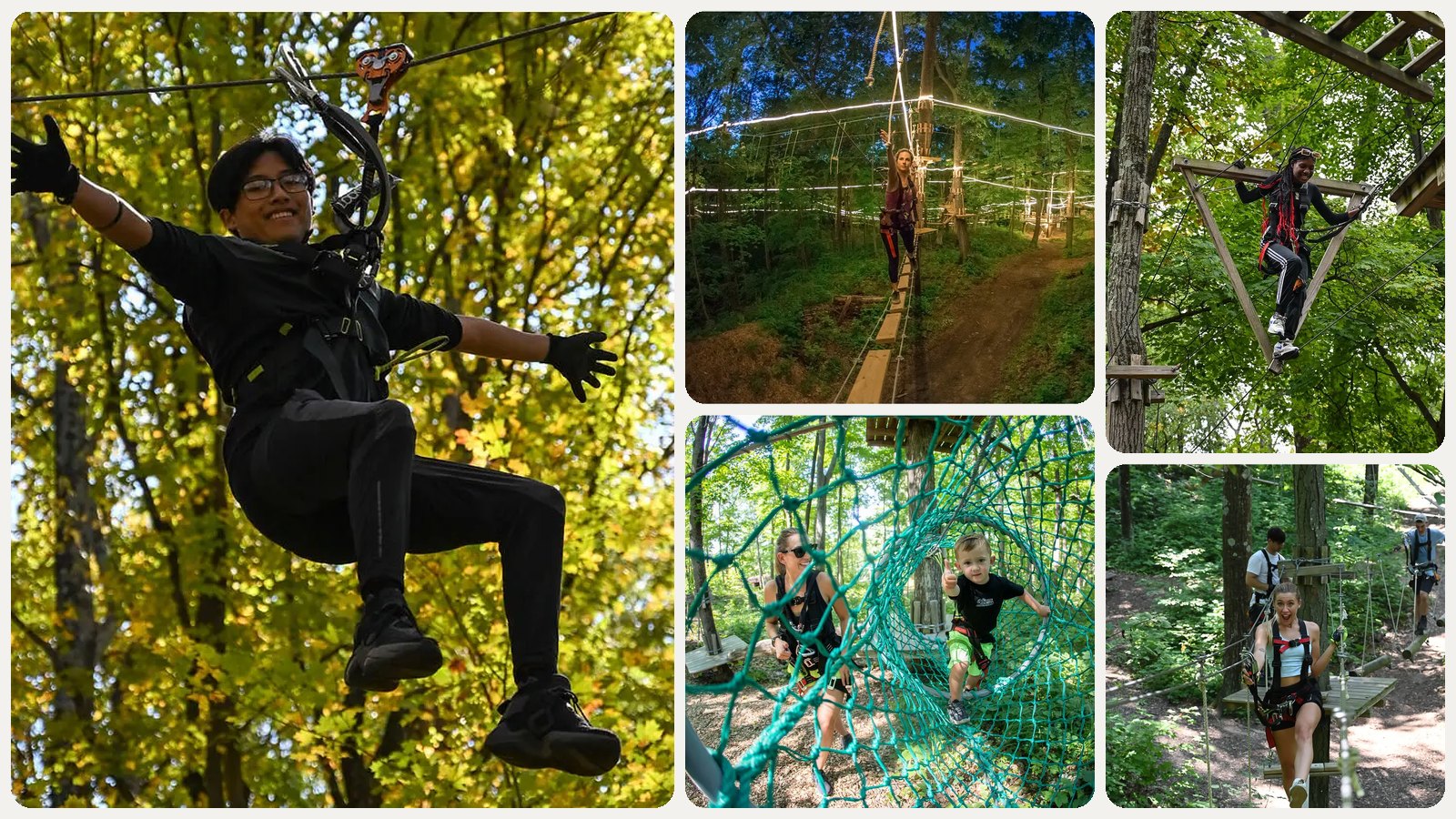
- Climb a high ropes course in the treetops
- Climb at night, under the lights
- Take a day trip somewhere you have never been
- Sign up for a race or a fun run
- Learn to kayak or paddleboard
- Go camping for one night
- Plan a surprise day out for a friend
Why TreEscape is a great place to start
If you want a monthly first that feels like a real adventure but does not need special skills, an aerial adventure park is hard to beat. TreEscape Aerial Adventure Park sits in a forest in Vernon, NJ, and is built around living trees, so the whole day happens in the canopy. It also gives you a choice of firsts, depending on how bold you feel.
For a gentle first: the Black Creek Flyer zip line
The Black Creek Flyer is a dedicated zip line course with 13 lines, more than 1,200 feet of cable and rides roughly 50 feet above the forest floor. There are no obstacles and no climbing, and you do not need upper-body strength. You clip in, step off the platform and let gravity do the work. It is open to riders 7 and up.
It is a good fit if you are nervous about heights. The first step off is the hard part. By the third line, most people are grinning.
For a challenge you can grow into: the aerial ropes courses
TreEscape has 10 color-coded aerial ropes courses, graded the way ski resorts grade their runs. You start on Yellow, where the heights are modest and the footing is stable, then move to Green and Blue as your confidence grows. At the top sits Driller’s Dare, the Black course, which you can only try after finishing a Blue course.
This is where the “something new” feeling really kicks in. Every element asks you to look, decide and commit: a swinging log, a wobbly bridge, a cargo net that gives more than you expect. You cannot think about emails while you work out where to put your foot next.
Kids get their own firsts too. The Purple courses in the Kids Park sit close to the ground and are built for climbers aged 4 to 6.
For a first you will talk about for weeks: a Night Climb
If you have already done a ropes course in daylight, try it after dark. On select dates, TreEscape lights up the courses for Night Climbs, and the same forest feels like a completely different place.
What other first-timers say
TreEscape has more than 740 reviews on Google, many from people who had never climbed before. One guest summed it up: “Fun for people of all ages! Definitely not just kids!” You can read more on the reviews page.
What to know before your first visit
[Image: Rectangle-25-cours.webp] Alt text: Family in harnesses smiling together after trying the aerial ropes course at TreEscape in Vernon, NJ
- When: the park is open seasonally, from May through November, on weekends and holidays, with Fridays added in summer. Check the current hours before you go.
- Book ahead: reservations are required, and weekends fill up first.
- Arrive 30 minutes early. That leaves time to park, check in and make the 10 to 15 minute hike into the park.
- Training first: every guest gets a harness fitting and a safety orientation with a training video and a practice course before climbing.
- What to wear: closed-toe and closed-heel shoes with good grip, and clothes you can move in. Tie back long hair.
- How long: a climbing ticket covers a 3-hour window. A combo with the zip line is about a 4-hour day.
- Who can climb: ages 4 and up (Kids Park), 7 and up for the zip line and main courses. Climbers must weigh 30 to 265 lbs.
- After: grab dinner at Hef’s Hut Bar & Grill next door. Climbers get 10% off with their wristband.
Frequently asked questions
What are some new things to try every day?
Small, easy firsts work best: a new route to work, a dish you have never ordered, a new album, a short workout, ten words in a new language or five minutes outside without your phone. The point is variety, not difficulty.
Does trying new things really improve your mood?
For many people, yes. Research has linked days with more variety to more positive emotions, and new experiences make weeks easier to remember. Small firsts also give you a quick sense of achievement.
What is a fun new thing to try on the weekend in New Jersey?
A zip line or an aerial ropes course makes a memorable weekend first. TreEscape in Vernon, NJ, has a 13-line zip line course and 10 color-coded ropes courses set in the forest, open from May through November.
Can beginners do a zip line or ropes course?
Yes. No experience is needed. At TreEscape, everyone gets a safety orientation and a practice course first, the zip line needs no climbing or upper-body strength, and the ropes courses start at an easy level.
How old do you have to be to climb at TreEscape?
Kids aged 4 to 6 can climb the Purple courses in the Kids Park. Riders 7 and up can do the Black Creek Flyer zip line and the main ropes courses, based on age and reach.
What should I wear to a ropes course?
Closed-toe and closed-heel shoes with good grip, like sneakers or hiking boots, plus clothes that are easy to move in. Tie back long hair and leave jewelry at home.
Make your next first a big one
Small daily firsts keep life interesting. The big ones are what you remember. If this is the month you want to try something new that you will talk about for a while, start in the trees.
Book your climb or zip line