The short answer: a ropes course trains balance because almost every surface moves under you. Swinging logs, wobbly beams and cargo nets force your body to make hundreds of small corrections, which works the systems behind balance: your inner ear, your sense of where your body is, and your eyes. Holding steady on those moving surfaces keeps your deep core muscles switched on the whole time, and reaching, stepping and gripping at once builds coordination. The best part is that balance is a skill, so it improves with practice, course by course.
From the ground, a ropes course looks like a test of nerve. Up on the platform, most people discover it is mostly a test of balance. The height gets your attention. The wobble is what does the work.
Here is what is actually happening in your body when you step onto a swinging log 30 feet up, and why it adds up to a surprisingly complete workout.
How your body keeps its balance
Balance feels automatic, but it is a constant conversation between three systems:
- Your inner ear (the vestibular system) senses head movement and which way is up.
- Proprioception is your sense of where your body parts are, picked up by sensors in your muscles, tendons and joints. It is how you can touch your nose with your eyes closed.
- Your eyes tell your brain where you are compared with everything around you.
Your brain blends all three and sends quick instructions to your muscles: shift a little left, tighten the ankle, bend the knee. On flat ground this happens in the background. On a surface that moves, it becomes a full-time job.
Why a ropes course is a natural balance workout
Most of daily life happens on floors that do not move. Sidewalks, offices and kitchens ask very little of your balance systems, so they never get much practice.
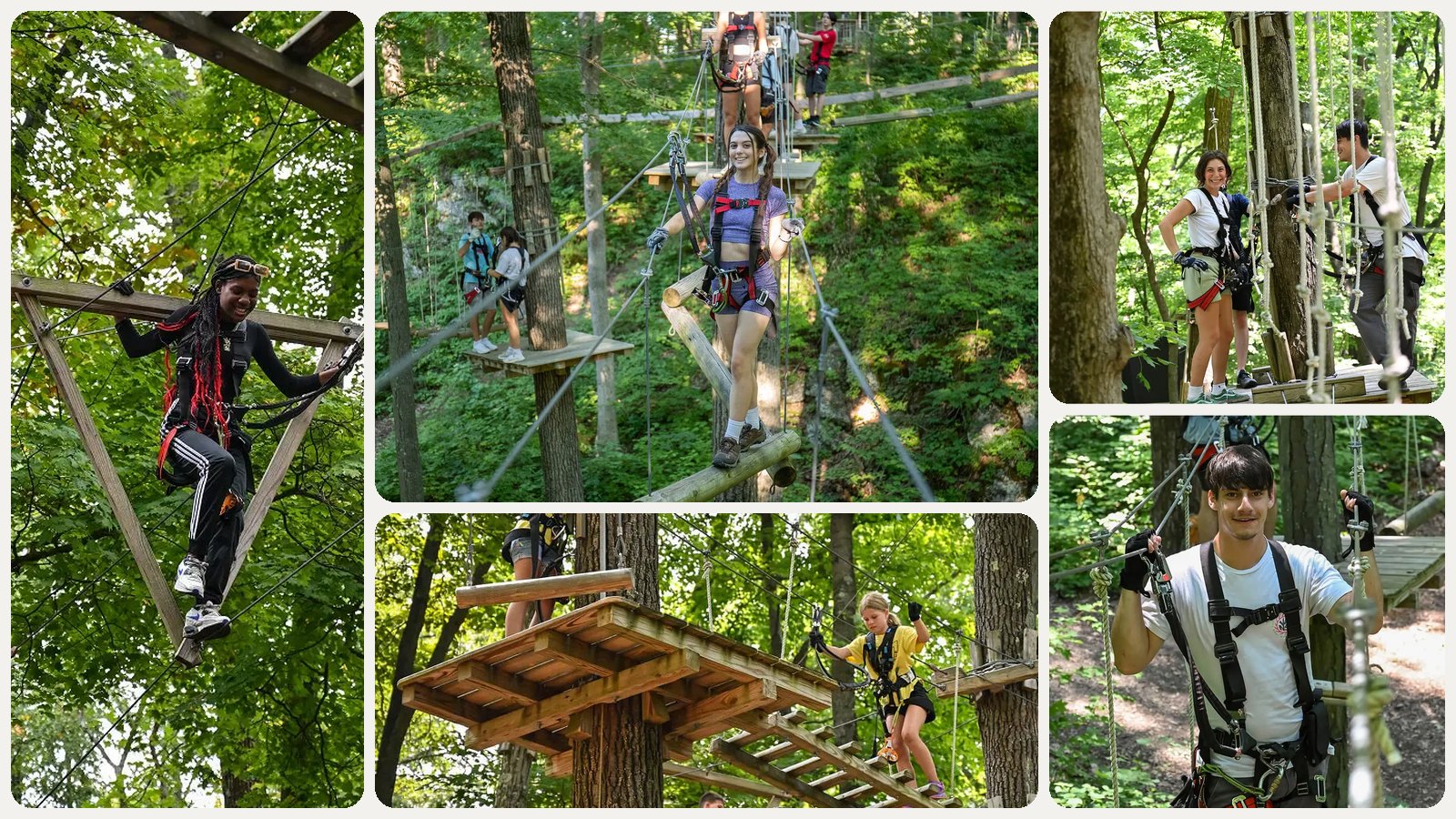
A high ropes course flips that. The bridges sway, the logs swing and the nets give as you put weight on them. Your feet send a stream of new information, your brain answers with a stream of corrections, and your muscles carry them out in fractions of a second.
That is the same idea behind the wobble boards and balance pads in a physical therapy clinic. The difference is that on a ropes course you are crossing a bridge between two trees, so it never feels like an exercise.
How a high ropes course works your core
When people hear “core,” they picture abs. Your real core is a ring of muscles that wraps around your middle: the deep abdominal muscles, the obliques along your sides, the muscles along your spine and the hips that connect it all to your legs.
On a ropes course, those muscles never get a break. Every time a log shifts, your core tightens to keep your upper body over your feet. Every time you reach for the next cable, it holds your trunk steady so your arms can do their job. Climbers often notice it the next day, in muscles they did not know they had.
The good news is that this kind of core work is about control, not raw strength. You do not need to do a single crunch to benefit.
Coordination is a skill your brain learns
Here is the encouraging part: balance and coordination improve with practice, at any age. Each time you cross an unstable surface, your brain gets a little better at predicting what will happen and correcting for it.
You can feel this happen in a single visit. The first bridge feels shaky. By the third, your knees are softer, your steps are smoother and you are looking ahead instead of down. That is your nervous system learning in real time.
This is also why ropes courses build confidence. Watching your own body figure something out is a good feeling, and it tends to stick.
Ropes courses for adults: why balance matters more with age
Balance starts to decline gradually in adulthood, mostly because we stop challenging it. Kids balance on curbs and climb trees without thinking. Adults mostly walk on flat ground.
That matters. Exercise that includes balance training is one of the best-supported ways to lower the risk of falls later in life. A ropes course will not replace a training plan, but it is a fun way to give your balance systems a real workout on a weekend.
If you are searching for a ropes course near you for adults, the courses at TreEscape are built for grown-ups as much as kids. There is no upper age limit. What matters is that climbers weigh between 30 and 265 lbs, can follow the safety instructions, and start on an easier course before moving up.
How to get more out of every course
A few habits make a big difference, both for balance and for energy:
- Let your legs do the work. Keep a slight bend in your knees and use your arms for balance, not for pulling.
- Loosen your grip. Squeezing the cables tightly makes you stiff, and stiff bodies balance worse.
- Look ahead, not down. Your body follows your eyes. Looking at the next platform keeps your posture upright.
For more detail, read our guide to ropes course techniques that save energy.
An aerial adventure course built around living trees
TreEscape Aerial Adventure Park in Vernon, NJ, is an aerial adventure course built directly into the forest, with platforms anchored around living trees rather than poles. That matters for balance training too, because the trees and the elements move naturally, so no two crossings feel exactly the same.
- 10 color-coded courses with 150+ aerial elements, set up to 50 feet above the forest floor
- Start easy, then progress: everyone begins on a Yellow or Green course, then moves up to Blue and finally Driller’s Dare, the Black course, which you can only try after finishing a Blue course
- Safety first: every climber gets a harness fitting and a safety orientation with a training video and a practice course, and stays clipped to the lifeline through the Smart Belay system
- Ages: 7 and up on the main courses, and 4 to 6 on the Purple courses in the Kids Park
- Time: a ticket covers a 3-hour window, and most people spend 2 to 4 hours in the trees
- Season: open from May through November, and reservations are required
See all the levels on the aerial ropes courses page, or read what makes a high ropes course challenging and fun.
Frequently asked questions
What are the benefits of a ropes course?
A ropes course improves balance, coordination and core strength, because most elements move under your feet and your body has to keep correcting. It also builds confidence and focus, and it is a full-body workout that does not feel like exercise.
Do high ropes courses build core strength?
Yes. Staying steady on swinging logs, bridges and ladders keeps your deep abdominal muscles, obliques and lower back working the whole time. It is control-based core work rather than heavy lifting.
Are ropes courses good for adults?
Very. Balance tends to decline when it is not challenged, and balance training is linked to a lower risk of falls later in life. At TreEscape there is no upper age limit, and climbers must weigh between 30 and 265 lbs.
Do I need to be fit to do a high ropes course?
No. You do not need special strength or experience. Courses start at an easy level, and good technique matters more than muscle. Using your legs and keeping a relaxed grip saves energy.
What is an aerial adventure course?
An aerial adventure course is a series of elevated obstacles, such as bridges, beams, nets, ladders and zip lines, that you cross while clipped to a safety system. At TreEscape the course is built around living trees in a forest in Vernon, NJ.
Where can I find a ropes course near me for adults in New Jersey?
TreEscape Aerial Adventure Park is at 414 County Road 517, Vernon Township, NJ. It has 10 courses for adults and kids, open from May through November.
Put your balance to the test
Your balance gets better every time you challenge it. A few hours in the trees challenges it hundreds of times, and you get a forest view while you are at it.
Book your climb