The first zip is always the loudest. Not the cable, which hums more than it screams, but the person hanging from it. Somewhere between the first platform and the next tree, almost every first-timer lets out a noise they did not plan on making. By the third line that yelp usually turns into a laugh. By the last one, people are already asking when they can come back.
If you have typed “tree top zipline near me” or “tree ziplining near me” into your phone lately, you have probably noticed that not all ziplines are the same animal. Some fling you across a mountain valley. Some run along the ceiling of a family fun center. And some, like the one we are about to walk you through, weave from tree to tree inside a real forest.
This guide covers what actually happens on a forest zipline course, from parking the car to unclipping at the end, and how that experience stacks up against open-air and indoor ziplines. There is a comparison table and a printable checklist further down, so feel free to skip ahead if you are the planning type.
What is a zipline adventure, anyway?
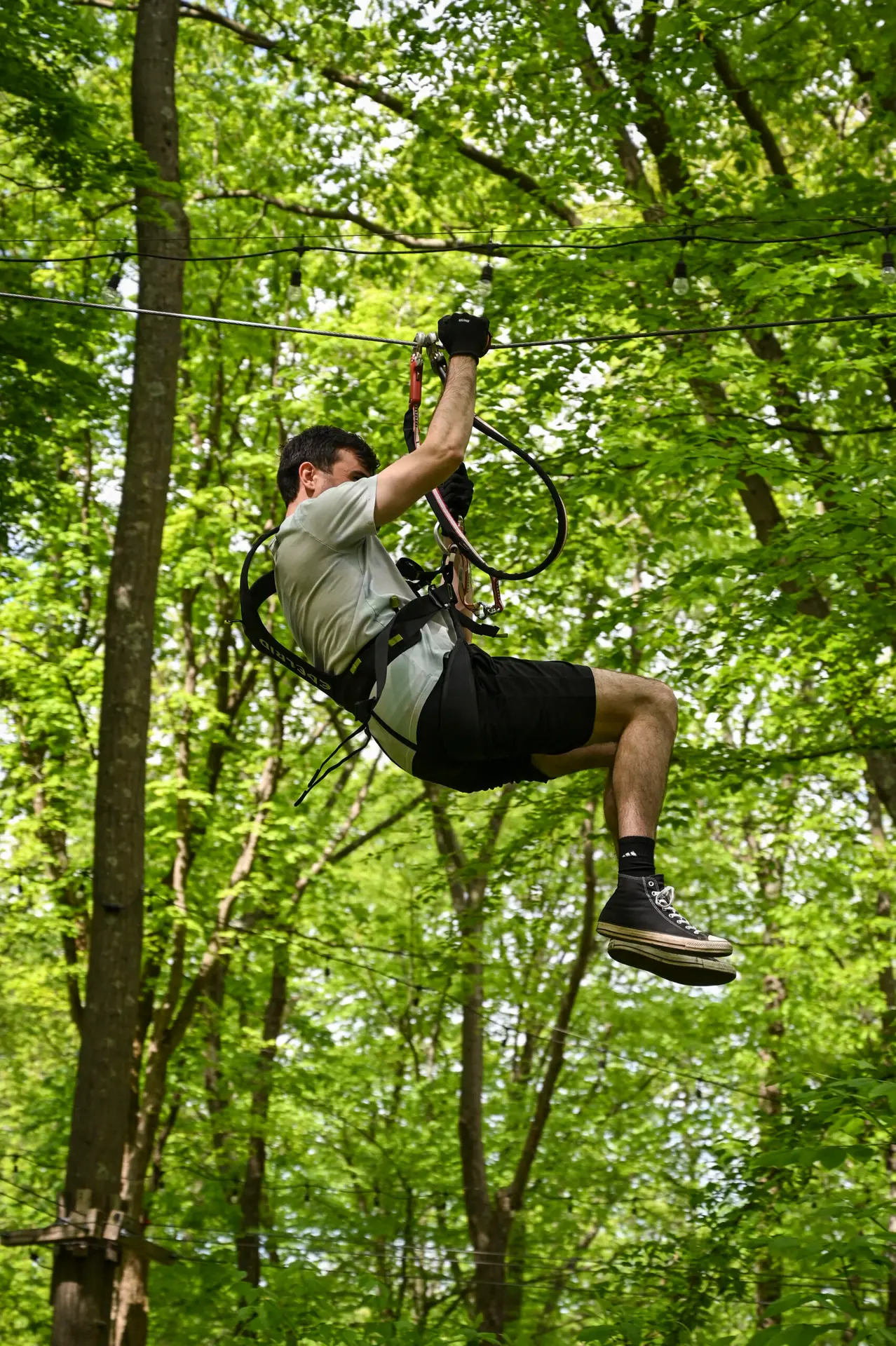
At its simplest, a zipline is a steel cable strung between two points, one a little higher than the other. You wear a harness, clip onto the cable with a trolley (a set of pulleys), step off, and gravity does the rest. No engine, no track, no steering wheel.
A zipline adventure is what happens when you string several of those lines together into a course. Instead of one big ride and a walk back to the car, you move from platform to platform, line after line, so the experience has a rhythm to it: launch, glide, land, breathe, repeat.
That rhythm is the part people tend to underestimate. A single zip is a thrill. A sequence of them, especially in a forest, becomes something closer to a journey. You settle in. Your shoulders drop. You start looking around instead of staring at the platform in front of you.
What makes a forest zipline its own thing
A forest zipline adventure is built into the trees themselves. The platforms sit on or between living trunks, and the cables run through the canopy rather than high above it. That changes almost everything about how it feels.
You are inside the scenery, not above it. On a mountain zipline you look down at the landscape. In a forest you move through it, with branches passing on either side and light flickering through the leaves. It is a bit like the difference between flying over a city and riding a bike through it.
The lines are shorter and there are more of them. Forest courses cannot run a single cable half a mile, because trees get in the way. So instead of one or two long rides, you get a series of shorter ones. Many people find this more fun, since there is always another launch just ahead.
Speed feels faster than it is. Tree trunks rushing past create a strong sense of motion, even at moderate speeds. On a long open-air line you can hit much higher speeds and feel oddly calm, because nothing nearby gives your brain a reference point.
It smells, sounds and feels like a forest. Sap, damp leaves, birdsong, the creak of big trunks in the wind. If you have read about the benefits of forest bathing, a forest zipline is a livelier version of the same idea. You get the fresh air and the green, plus a healthy dose of adrenaline.
The weather is gentler. A canopy blocks a lot of wind and sun. On a hot July afternoon the forest can feel noticeably cooler than an exposed hillside, and on a breezy day the lines feel steadier.
Your visit, step by step
To make this concrete, here is what a visit to the Black Creek Flyer at TreEscape Adventure Park in Vernon, New Jersey looks like. TreEscape is built right into a forest in the Vernon Valley, which is exactly why it is a useful example.
Before you arrive
Book ahead. TreEscape is open on Saturdays, Sundays and holidays from May through November, plus Fridays during the summer, and groups can reserve other days in advance. Weekends in the fall tend to fill up, for reasons that will be obvious the moment you see the leaves.
The park asks guests to arrive 20 to 30 minutes before their reservation time. Parking is free. If you are bringing a friend who would rather keep their feet on the ground, spectators do not need a ticket and can watch and take photos from the trails.
Gearing up
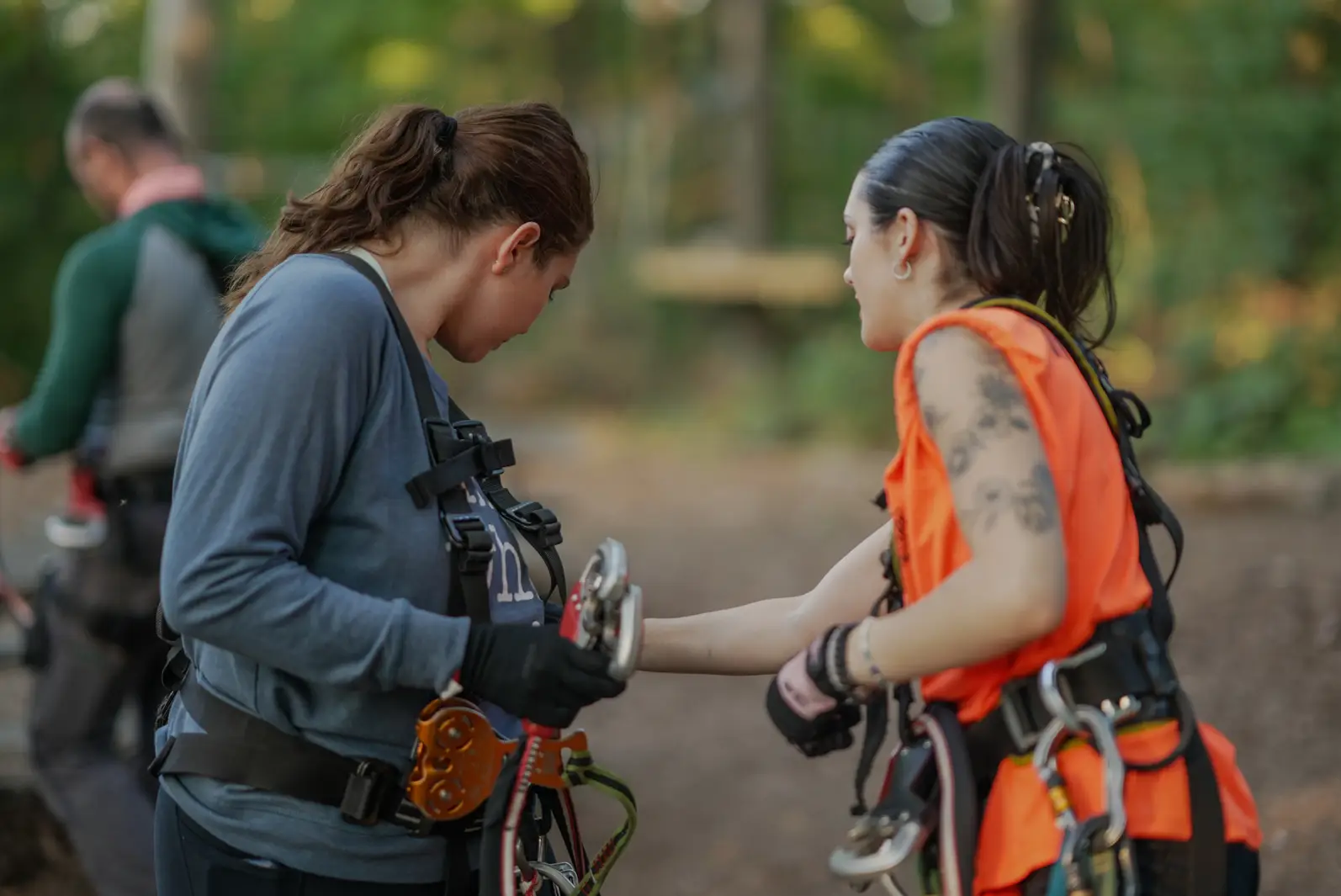
Staff will fit you with a harness, a safety lanyard, a trolley and gloves. The harness has to be the outermost layer you wear, so leave the zip-up hoodie over the top of it in the car, or plan to wear it underneath. After the fitting you get a short set of instructions on how everything works. Listen closely. It is quick, and it is the reason the rest of the day feels easy.
The course itself
The Black Creek Flyer opened in 2022 and is a dedicated zipline course, separate from the park’s aerial ropes courses. Here is what you are signing up for:
- More than 1,200 feet of zip lines in total, spread across 15 lines that range from roughly 50 to 150 feet each
- Heights of up to 50 feet above the forest floor
- One platform leads straight into the next launch, so you are not constantly climbing towers between rides
- No rope bridges, nets or balance challenges between lines, which means no advanced climbing skills or upper-body strength required
- Automatic braking, so you do not have to slow yourself down with a gloved hand
- About 60 to 90 minutes from first launch to last landing
The lines run above the trees and old quarries of the Great Gorge area, so the view changes as you go. Some stretches feel enclosed and green. Others open up just enough to remind you how high you actually are.
If you want more than zipping
TreEscape also runs aerial ropes courses with more than 100 obstacles across 11 courses, from beginner to expert. A combo ticket pairs a traditional aerial course with the Black Creek Flyer, and the park says that combo can take up to 4.5 hours. Ticket prices range from about $25 for a children’s ticket to $95 for a full combo, but check the booking page for current rates before you go.
Forest vs. open-air vs. indoor ziplines
Here is how the three main types compare. Numbers for open-air and indoor ziplines vary a lot from place to place, so treat those columns as typical ranges rather than rules.
| Forest zipline | Open-air (mountain) zipline | Indoor zipline |
|---|---|---|
| Through the tree canopy, platform to platform | Across valleys, ski slopes or open terrain | Inside a building, usually near the ceiling |
| Short to medium, many lines in a row | Long, sometimes thousands of feet per line | Short, often a single run or loop |
| High, because trees rush past | Varies; the biggest lines advertise speeds of 50 mph or more | Low to moderate |
| Usually 20 to 60 feet | Can be hundreds of feet off the ground | Usually under 30 feet |
| Leaves, bark, dappled light, wildlife | Wide views and big landscapes | Walls, lights, the rest of the venue |
| Partly sheltered; closes for storms | Fully exposed; wind can pause rides | Climate controlled, open year round |
| Many (Black Creek Flyer has 15) | Usually 1 to 6 | Often 1, sometimes repeatable |
| 1 to 2 hours for a course | 1 to 3 hours including transport | 5 to 30 minutes |
| Families, first-timers, nature lovers, groups | Thrill-seekers who want raw speed | Young kids, rainy days, birthday add-ons |
A closer look at indoor ziplines
Indoor ziplines have become a popular add-on at trampoline parks, family entertainment centers and some climbing gyms. They are a great first taste for younger kids, since the height is modest and nobody has to worry about the weather. Some run on a rigid overhead track instead of a cable, which feels more like a gentle ride than a true zip.
The trade-off is scale. Most indoor runs are short, and once you have done one or two laps, you have seen it. If an indoor zipline is what got your kids hooked, a forest course is a natural next step: still manageable, but with real trees, real height and a lot more to look at.
A closer look at open-air ziplines
Mountain and valley ziplines are about the big moment. You climb or ride a lift to a high launch point, step off, and cross a huge gap in one go. They can be spectacular, and some are genuinely fast.
They also tend to have fewer rides and more waiting, and the exposure means wind can slow things down. If you want a single jaw-dropping crossing, an open-air line is hard to beat. If you want a longer, more varied experience that keeps you moving, a forest course usually delivers more zips per hour.
Which type suits you?
- You are nervous about heights. Start with a forest course. The trees around you make the height feel less abstract, and the lines are short enough that each one is over before your nerves catch up.
- You have kids between 7 and 12. A forest course like the Black Creek Flyer, which welcomes guests 7 and up, is a sweet spot. Younger kids (4 to 6) might start on a dedicated kids’ course instead; TreEscape has one.
- You are planning a group outing. Forest courses work well because everyone moves together along the same route. TreEscape books corporate outings, school trips, scout groups, camps and birthday parties.
- You want pure speed. A long open-air line will scratch that itch.
- It is January and pouring rain. Indoor, no contest.
The after-dark version
TreEscape also runs Night Climbs, usually every other Saturday in season. The courses are lit by lights strung through the trees, and the forest takes on a completely different personality once the sun goes down. Sounds seem closer, the air cools off, and the glowing path ahead makes each launch feel a little cinematic.
Night sessions generally suit guests 10 and older and tend to sell out, especially on fall weekends, so book early. Read more about it on the night ziplining page.
Checklist: what to wear and bring
Screenshot this or print it and stick it on the fridge the night before. Arriving dressed for the course makes check-in, harnessing, and your time in the trees much smoother.
Comfortable, fitted, and ready to move
Closed-toe sneakers, hiking shoes, or boots. No sandals or Crocs.
Fitted athletic clothing that will not hang loose or catch on ropes.
Light layers you can wear under the harness.
Hair tied back if it is long.
Anything that can snag or fall
Jewelry, especially rings, bracelets, and dangling earrings.
Loose bags, purses, and anything hanging from your belt.
Scarves and long drawstrings.
The essentials for a full day outside
Water, for before and after.
Sunscreen and bug spray. Apply before gear-up.
A phone strap or zip pocket if you plan to take photos.
A harness, safety lanyard, trolley, and gloves are provided. Your harness should be worn as the outermost layer, so plan your clothing accordingly.
Honest answers to the nerves
“What if I freeze on the platform?” It happens, and staff have seen it plenty of times. Most people who hesitate on the first launch are fine by the second. The trick is not to look at the ground. Look at the next tree.
“Will my arms get tired?” Not on a dedicated zip course. You are sitting in the harness, not holding yourself up. The Black Creek Flyer also has no climbing obstacles between lines.
“What if I stop halfway?” On short, well-designed forest lines this is uncommon, but if it does happen, staff will talk you through getting to the platform. It is more awkward than dangerous.
“Is it scary?” For about four seconds. Then it is mostly fun.
FAQ
What is a zipline adventure?
A zipline adventure is a course of connected ziplines where you travel from platform to platform while wearing a harness attached to a steel cable. A forest zipline adventure places those platforms and cables in the trees, so you move through the canopy rather than over open ground.
Is a forest zipline safer than an open-air zipline?
Both types can be very safe when they are well built and well run. The main differences are height, speed and exposure. Forest courses are usually lower and slower, which many first-timers find more comfortable.
How is an indoor zipline different from a forest zipline? An indoor zipline runs inside a building, is usually short and low, and is open in any weather. A forest zipline is longer, higher and made up of several connected lines, with real trees and wildlife around you.
How long does the Black Creek Flyer take?
Plan on 60 to 90 minutes on the course. The park recommends arriving 20 to 30 minutes early for check-in and gear fitting.
How old do you have to be to zipline at TreEscape?
The Black Creek Flyer is for guests 7 and older. TreEscape has courses for kids as young as 4, and Night Climbs generally suit guests 10 and up.
Are there weight limits?
Yes. Riders must be between 36 inches and 6’8″ tall, and between 30 and 265 pounds.
What happens if it rains? TreEscape is open rain or shine but may close for thunder, lightning or high winds. The park does not offer refunds, but it can offer time extensions or vouchers, and the rescheduling fee is waived if it is raining on the day of your visit.
Do I need to be fit or strong? No. The Black Creek Flyer requires no advanced climbing skills or upper-body strength, since there are no obstacles between lines and the brakes are automatic.
Can friends come watch?
Yes. Spectators do not need a ticket and can follow along on the trails.
Where is the nearest tree top zipline to northern New Jersey?
TreEscape Adventure Park is at 414 County Road 517 in Vernon Township, NJ 07462, in the Vernon Valley of Sussex County. It is an easy drive from much of North Jersey and the lower Hudson Valley.
Ready when you are
Forest ziplining sits in a sweet spot. It is more adventurous than an indoor ride, more relaxed and varied than a single mountain line, and it happens inside one of the nicest places you can spend a Saturday: a real forest, from 50 feet up.
If you are looking for tree ziplining near you in North Jersey, book the Black Creek Flyer or call the park at 862-801-7028 with any questions. Wear the sneakers. Tie back the hair. And do not worry about that first yelp. Everybody makes it.