For climbers looking for more than a casual day in the trees, TreEscape’s Blue and Black courses offer a completely different kind of adventure. Featuring advanced ropes course obstacles, greater heights, longer crossings, and technical balance challenges, these aerial courses are designed for guests who want to test both their physical abilities and mental focus.
This guide covers everything you need to know before taking on TreEscape’s most challenging high ropes experiences, including obstacle strategies, energy-saving techniques, safety tips, and what makes these courses some of the most rewarding adventures in New Jersey.
When the trees start feeling a little taller
There is a really cool shift that happens when you move beyond the beginner and intermediate tracks. It is not just about the actual height, though you will definitely notice the ground getting further away, and it is not even about the obstacles getting wilder. The real change is in how much the course starts demanding your full attention.
On the yellow and green courses, you spend most of your time just figuring things out. You are learning how the safety clips work, discovering how to move smoothly across wobbly bridges, and realizing just how much your balance matters when you cannot rely on the solid ground anymore. But by the time you feel ready to take on the Blue and Black courses, those basic movements have turned into second nature. You do not really have to think about the gear anymore. Instead, your mind shifts to reading the obstacles ahead, pacing your energy, and finding a natural rhythm as you move through the high canopy. It stops feeling like a casual afternoon activity and turns into a personal challenge that unfolds one platform at a time.
What makes the Driller Dare different?
Many people assume advanced high ropes courses are simply higher versions of beginner courses.
In reality, the difference is far more interesting.
The Blue courses aren’t necessarily designed to be intimidating. They’re designed to be engaging.
The obstacles often require more precise movement, longer stretches of balance, and a greater willingness to trust yourself when things become a little less stable beneath your feet.
You’ll encounter crossings that sway more than you’re used to. Platforms that feel farther apart. Obstacles that require a little patience before you figure out the best way to move through them.
And that’s where the fun begins.
Unlike activities where success depends on speed or strength alone, advanced ropes courses reward adaptability. Sometimes the person who moves slowly and deliberately has a much easier time than the person trying to rush through every challenge.
That’s one reason guests often finish the Blue courses feeling more accomplished than exhausted.
They haven’t simply completed a series of obstacles. They’ve learned how to work with them.
The Drillers Dare experience
Every adventure park has that one specific route that everyone stops to look at from the ground, and at TreEscape, that is the Drillers Dare course. It looks incredibly ambitious from down below, suspended high up in the treetops, and it immediately signals that you are in for a serious test if you choose to climb up there.
But what surprises most people is that conquering the Drillers Dare is not about being completely fearless. It is really just a matter of confidence. The climbers who have the best time up there are not necessarily the strongest or the fastest athletes in the park. They are simply the ones who have learned how to keep their cool, trust their gear, and take things one single step at a time.
When you are standing on a tiny platform completely surrounded by the forest canopy, dozens of feet in the air, that mental confidence is everything. It is not because you are in any danger, the safety systems are top-tier and designed to keep you completely secure the whole time, but because being confident lets you focus on the fun of the movement instead of letting the nerves take over. That mental shift is usually the secret ingredient to actually enjoying the climb.
The physics of the canopy. How to read the tension of the lines
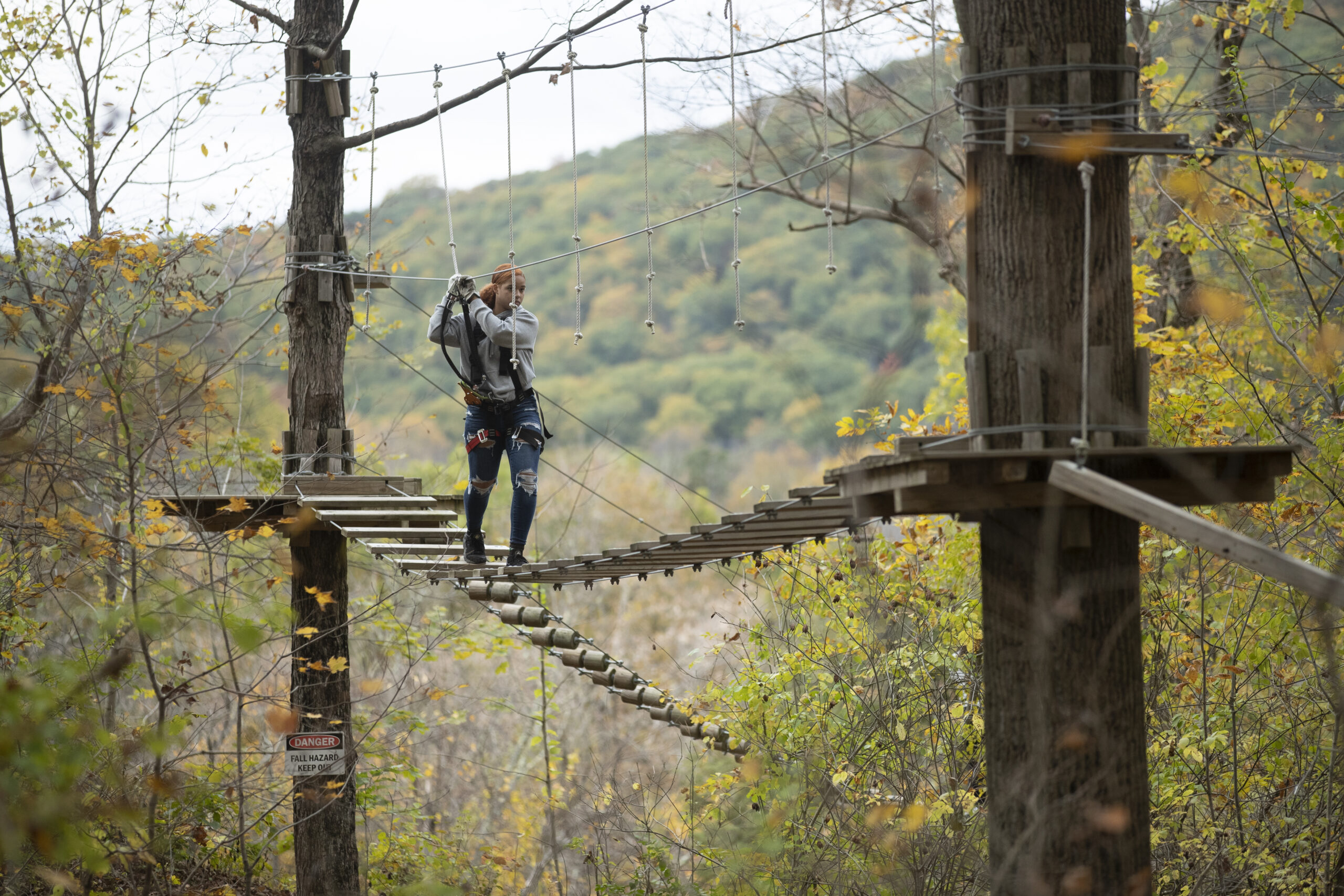
To truly master the higher courses, it helps to understand a bit of the tree-to-tree engineering beneath your feet. On the beginner tracks, the cables are usually short and tightly tensioned, meaning they stay relatively rigid when you step on them. But as you move onto the advanced blue and black routes, the spans between the trees get much longer. Long steel cables naturally have more slack and a lower frequency of vibration, which means they do not just sway left to right, they can ripple under your weight.
When you step onto a long, suspended cable, you are essentially introducing energy into a giant guitar string. If you step down hard and fast, that energy bounces back up through your legs, causing the cable to whip. Advanced climbers learn to read this tension before they ever leave the platform. They look at the length of the span and use a technique called “soft-stepping,” where you absorb the cable’s natural movement with bent knees, treating your legs like the shock absorbers on a truck. By matching your steps to the rhythm of the wire rather than fighting against it, you stop the line from oscillating, turning a wild, swinging bridge into a steady, manageable pathway.
The biggest mistake advanced climbers make
One of the most common mistakes on more challenging ropes course obstacles is assuming that harder effort automatically means better performance. When an element starts to sway or feel unstable, the instinct for a lot of climbers is to grip tighter, pull harder with their arms, and tense up through their shoulders, core, and hands. It feels like the safe thing to do in the moment, but it usually has the opposite effect. You burn through energy faster, your arms tire out sooner, and the obstacle often feels more difficult than it actually is.
The climbers who move most efficiently through advanced courses usually don’t look rushed or overly tense. They let their legs do more of the work, keep their movements steady, and allow the obstacle to move the way it naturally wants to move instead of trying to overpower every swing or shift. That doesn’t mean being careless; it means understanding that suspended bridges, ropes, and crossings are meant to have some motion. Once you stop fighting that and start moving with it, the course often feels smoother, more controlled, and much less exhausting by the end of the day.
Why advanced high ropes courses feel so rewarding

Most weekend activities give you a few nice memories, but advanced ropes courses tend to give you actual milestones. That is because every single obstacle creates this quick little cycle of uncertainty followed by a sudden rush of success. You look at a tough crossing, you wonder for a second if you can actually pull it off, and then you do it.
That process repeats itself over and over again, from platform to platform. By the time you zip line back down to earth at the end of the day, you have accumulated dozens of these little personal victories. It is a unique kind of satisfaction because the accomplishment feels entirely earned. The course was not impossible, but it asked you to step up, and it gave you a massive confidence boost in return.
A different perspective on the forest
One of the best parts of the advanced courses actually has nothing to do with how hard the climbing is. It is simply the view. Because TreEscape is built directly into the gorgeous natural mountain forest of Vernon, New Jersey, the higher up you go, the more the entire landscape opens up around you.
Up there, the sunlight filters through the leaves in a completely different way, and even the sounds of the woods change as you get closer to the treetops. You start noticing little natural details that you would completely miss from the ground. It is exactly why this place feels so different from a standard, manufactured obstacle course built in a field or an indoor warehouse. You are not just running through a set of gym challenges; you are actively moving through the living forest itself. Somewhere between the platforms and the bridges, you will probably find yourself slowing down just to take in where you are.
Why TreEscape stands out among forest adventure parks

What makes this place special is not just that the challenges are tough, but that the path to getting there makes total sense. The park is laid out so you can build your skills gradually before you ever try to tackle the advanced routes. Someone can show up having never even seen a harness before, and over a few visits, work their way up to courses they honestly thought were completely out of reach on day one.
The natural setting plays a huge part in that too. It never feels like a crowded, plastic amusement park attraction because it blends so cleanly into the hillside woods. Whether you are looking to test your limits on the highest platforms or just want to cruise through the trees on the dedicated zip line tracks, the layout keeps things immersive from the second you arrive to your very last climb.
Are you ready for the Blue and Black courses?
The best indicator that you are ready to move up isn’t your raw upper-body strength or how athletic you are. It is really just curiosity. If you have finished the green tracks and find yourself standing on the ground looking up at the blue lines wondering what it feels like up there, that is usually the only sign you need.
The Blue and Black courses are not locked away for elite athletes or survival experts. They are built for regular people who love being outside, enjoy a good puzzle, and want to see what happens when they step just a little bit outside their comfort zone. More often than not, that is exactly where the best stories come from.
Frequently Asked Questions
How difficult are TreEscape’s Blue courses?
The blue courses are definitely advanced and feature longer, more technical challenges than the beginner or intermediate routes. You will need a good sense of balance and focus, but they are totally accessible for anyone who can comfortably get through the green courses and feels ready for a bit more height.
What is the hardest course at TreEscape?
If you’re looking for the biggest challenge in the park, Drillers Dare (the black course) is the course to aim for. As TreEscape’s black-level route, it’s designed for climbers who are comfortable with heights and ready for more demanding obstacles, longer crossings, and a greater test of focus than the beginner and intermediate courses.
Do I need prior experience for advanced courses?
While there is no requirement to be an expert climber, most guests benefit from first completing Yellow and Green courses to become comfortable with the safety system and obstacle styles.
Are advanced ropes courses safe?
Yes. Participants use professional safety equipment and receive instruction before entering the courses. Following all safety guidelines is essential for a safe and enjoyable experience.
What should I wear?
Comfortable athletic clothing and closed-toe shoes are recommended. Gloves can also help some participants maintain a comfortable grip throughout longer sessions.
How long does it take to complete the Blue and Black courses?
Completion times vary depending on pace, experience level, and crowd conditions, but advanced courses generally require more time than beginner routes due to their complexity.
Is TreEscape worth visiting if I live near New York City?
Absolutely. Located in Vernon, New Jersey, TreEscape is a popular destination for visitors from both New Jersey and New York looking for a forest adventure park experience that feels far removed from city life without requiring a long trip.
Park Overview
Read More →